 On July 17, 1962, Major Robert White flew the X-15 to an altitude of 314,750 feet, or 59 miles, becoming the first "winged astronaut." He was the first to fly at Mach 4, Mach 5 and Mach 6; he was the first to fly a winged vehicle into space. After a career of 'firsts' White died on March 17, 2010.
White was one of the initial pilots selected for the X-15 program, representing the Air Force in the joint program with NASA, the Navy, and North American Aviation. Between April 13, 1960, and Dec. 14, 1962, he made 16 flights in the rocket-powered aircraft.
His July 17, 1962, flight to an altitude of 314,750 feet set a world record. This was 59.6 miles, significantly higher than the 50 miles the Air Force accepted as the beginning of space, qualifying White for astronaut wings. The X-15 rocket-powered aircraft were built by North American Aviation and developed to provide in-flight information and data on aerodynamics, structures, flight controls and the physiological aspects of high-speed, high-altitude flight.
A follow-on program used the aircraft as testbeds to carry various scientific experiments beyond the Earth's atmosphere on a repeated basis. Information gained from the highly successful X-15 program contributed to the development of the Mercury, Gemini and Apollo manned spaceflight programs, and also the space shuttle program. The X-15s made a total of 199 flights and the first aircraft X-15-1, serial number 56-6670, is now located at the National Air and Space Museum in Washington, D.C.
According to an article by Al Hallonquist, White's achievements as an X-15 pilot "allowed him to become the fifth American to attain astronaut wings and only the second Air Force pilot to do this."


 New studies of ripples and dunes shaped by the winds on



 Imagine holding the entire sun in the palm of your hand. Now you can. A new iPhone app developed by
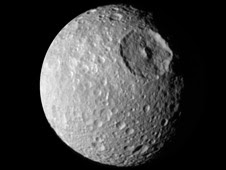 On Feb. 13, 2010, NASA's Cassini spacecraft will make its closest examination yet of Mimas, an eyeball-shaped moon of Saturn that has also been likened to the Death Star of "Star Wars." The spacecraft will be returning the highest-resolution images yet of this battered satellite.



 Asteroid 2010 AL30, discovered by the LINEAR survey of MIT's Lincoln Laboratories on Jan. 10, will make a close approach to the Earth's surface to within 76,000 miles on Jan. 13 at 12:46 pm Greenwich time (7:46 am EST, 4:46 am PST). Because its orbital period is nearly identical to the Earth's one year period, some have suggested it may be a manmade rocket stage in orbit about the sun. However, this object's orbit reaches the orbit of Venus at its closest point to the sun and nearly out to the orbit of Mars at its furthest point, crossing the Earth's orbit at a very steep angle. This makes it very unlikely that 2010 AL30 is a rocket stage. Furthermore, trajectory extrapolations show that this object cannot be associated with any recent launch and it has not made any close approaches to the Earth since well before the Space Age began.


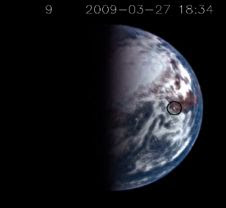 In two new videos from NASA’s Deep Impact spacecraft, bright flashes of light known as sun glints act as beacons signaling large bodies of water on Earth. These observations give scientists a way to pick out planets beyond our solar system (extrasolar planets) that are likely to have expanses of liquid, and so stand a better chance of having life.


 A network of cameras deployed around the Arctic in support of NASA's THEMIS mission has made a startling discovery about the Northern Lights. Sometimes, vast curtains of aurora borealis collide, producing spectacular outbursts of light. Movies of the phenomenon were unveiled at the Fall Meeting of the American Geophysical Union today in San Francisco.


