Thursday, February 10, 2011

Heading Into the Bonus Round – in Space


NASA's Stardust spacecraft was launched on Feb. 7, 1999, on a mission that would explore a comet as no previous mission had. Before Stardust, seven spacecraft from NASA, Russia, Japan and the European Space Agency had visited comets – they had flight profiles that allowed them to perform brief encounters, collecting data and sometimes images of the nuclei during the flyby.

Like those comet hunters before it, Stardust was tasked to pass closely by a comet, collecting data and snapping images. It also had the ability to come home again, carrying with it an out-of -this-world gift for cometary scientists – particles of the comet itself. Along the way, the telephone booth-sized comet hunter racked up numerous milestones and more than a few "space firsts."


Tuesday, February 08, 2011

NASA Hosting Events for Valentine's Night Comet Encounter

NASA will host several live activities for the Stardust-NExT mission's close encounter with comet Tempel 1. The closest approach is expected at approximately 8:37 p.m. PST (11:37 p.m. EST) on Feb. 14, with confirmation received on Earth at about 8:56 p.m. PST (11:56 p.m. EST).

Live coverage of the Tempel 1 encounter will begin at 8:30 p.m. PST on Feb. 14 on NASA Television and the agency's website. The coverage will include live commentary from mission control at NASA's Jet Propulsion Laboratory in Pasadena, Calif., and video from Lockheed Martin Space System's mission support area in Denver.

LRO Could Have Given Apollo 14 Crew Another Majestic View

Although the Apollo 14 mission to the moon was filled with incredible sights and was completely successful it met all its science goals the crew experienced a bit of a disappointment at missing the spectacular view from the rim of a 1,000-foot-wide crater. They might have gazed into its depths if they had the high-resolution maps now available from NASA's Lunar Reconnaissance Orbiter (LRO) spacecraft.

Pressure was on the Apollo 14 mission, launched January 31, 1971, from the start. The Apollo 13 landing had to be aborted because an oxygen tank explosion crippled the spacecraft as it was on its way to the moon. It was a heroic effort just to return the crew safely to Earth, but the Apollo 14 team knew a second failure would probably result in cancellation of the remaining Apollo missions.

Monday, February 07, 2011

First Ever STEREO Images of the Entire Sun

On Feb. 6th, NASA's twin STEREO probes moved into position on opposite sides of the sun, and they are now beaming back uninterrupted images of the entire star—front and back.

"For the first time ever, we can watch solar activity in its full 3-dimensional glory," says Angelos Vourlidas, a member of the STEREO science team at the Naval Research Lab in Washington, DC.

"This is a big moment in solar physics," says Vourlidas. "STEREO has revealed the sun as it really is--a sphere of hot plasma and intricately woven magnetic fields."

Each STEREO probe photographs half of the star and beams the images to Earth. Researchers combine the two views to create a sphere. These aren't just regular pictures, however. STEREO's telescopes are tuned to four wavelengths of extreme ultraviolet radiation selected to trace key aspects of solar activity such as flares, tsunamis and magnetic filaments. Nothing escapes their attention.

Thursday, February 03, 2011

Surprise Hidden in Titan's Smog: Cirrus-Like Clouds

Every day is a bad-air day on Saturn's largest moon, Titan. Blanketed by haze far worse than any smog belched out in Los Angeles, Beijing or even Sherlock Holmes's London, the moon looks like a dirty orange ball. Described once as crude oil without the sulfur, the haze is made of tiny droplets of hydrocarbons with other, more noxious chemicals mixed in. Gunk.

Icky as it may sound, Titan is really the rarest of gems: the only moon in our solar system with an atmosphere worthy of a planet. This atmosphere comes complete with lightning, drizzle and occasionally a big, summer-downpour style of cloud made of methane or ethane -- hydrocarbons that are best known for their role in natural gas.

Now, thin, wispy clouds of ice particles, similar to Earth's cirrus clouds, are being reported by Carrie Anderson and Robert Samuelson at NASA's Goddard Space Flight Center in Greenbelt, Md. The findings, published February 1 in Icarus, were made using the Composite Infrared Spectrometer (CIRS) on NASA's Cassini spacecraft.

Wednesday, February 02, 2011

NASA's Kepler Spacecraft Discovers Extraordinary New Planetary System

Scientists using NASA's Kepler, a space telescope, recently discovered six planets made of a mix of rock and gases orbiting a single sun-like star, known as Kepler-11, which is located approximately 2,000 light years from Earth.

"The Kepler-11 planetary system is amazing," said Jack Lissauer, a planetary scientist and a Kepler science team member at NASA's Ames Research Center, Moffett Field, Calif. "It’s amazingly compact, it’s amazingly flat, there’s an amazingly large number of big planets orbiting close to their star - we didn’t know such systems could even exist."

In other words, Kepler-11 has the fullest, most compact planetary system yet discovered beyond our own.

"Few stars are known to have more than one transiting planet, and Kepler-11 is the first known star to have more than three," said Lissauer. "So we know that systems like this are not common. There’s certainly far fewer than one percent of stars that have systems like Kepler-11. But whether it’s one in a thousand, one in ten thousand or one in a million, that we don’t know, because we only have observed one of them."

Cassini Sends Back Postcards of Saturn Moons

On Jan. 31, 2011, NASA's Cassini spacecraft passed by several of Saturn's intriguing moons, snapping images along the way. Cassini passed within about 60,000 kilometers (37,282 miles) of Enceladus and 28,000 kilometers (17,398 miles) of Helene. It also caught a glimpse of Mimas in front of Saturn's rings. In one of the images, Cassini is looking at the famous jets erupting from the south polar terrain of Enceladus.

The Cassini-Huygens mission is a cooperative project of NASA, the European Space Agency and the Italian Space Agency. The Jet Propulsion Laboratory, a division of the California Institute of Technology in Pasadena, manages the Cassini-Huygens mission for NASA's Science Mission Directorate, Washington. The Cassini orbiter and its two onboard cameras were designed, developed and assembled at JPL. The imaging team is based at the Space Science Institute in Boulder, Colo.

Tuesday, February 01, 2011

Tracking the Origins of Speedy Space Particles


NASA's Time History of Events and Macroscale Interaction during Substorms (THEMIS) spacecraft combined with computer models have helped track the origin of the energetic particles in Earth's magnetic atmosphere that appear during a kind of space weather called a substorm. Understanding the source of such particles and how they are shuttled through Earth's atmosphere is crucial to better understanding the Sun's complex space weather system and thus protect satellites or even humans in space.

The results show that these speedy electrons gain extra energy from changing magnetic fields far from the origin of the substorm that causes them. THEMIS, which consists of five orbiting satellites, helped provide these insights when three of the spacecraft traveled through a large substorm on February 15, 2008. This allowed scientists to track changes in particle energy over a large distance. The observations were consistent with numerical models showing an increase in energy due to changing magnetic fields, a process known as betatron acceleration.

"The origin of fast electrons in substorms has been a puzzle," says Maha Ashour-Abdalla, the lead author of a Nature Physics paper that appeared online on January 30, 2011 on the subject and a physicist at the University of California, Los Angeles. "It hasn't been clear until now if they got their burst of speed in the middle of the storm, or from some place further away."

Sunday, January 30, 2011

NASA Comet Hunter Spots Its Valentine


NASA's Stardust spacecraft has downlinked its first images of comet Tempel 1, the target of a flyby planned for Valentine's Day, Feb. 14. The images were taken on Jan. 18 and 19 from a distance of 26.3 million kilometers (16.3 million miles), and 25.4 million kilometers (15.8 million miles) respectively. On Feb. 14, Stardust will fly within about 200 kilometers (124 miles) of the comet's nucleus.

"This is the first of many images to come of comet Tempel 1," said Joe Veverka, principal investigator of NASA's Stardust-NExT mission from Cornell University, Ithaca, N.Y. "Encountering something as small and fast as a comet in the vastness of space is always a challenge, but we are very pleased with how things are setting up for our Valentine's Day flyby."

The composite image is a combination of several images taken by Stardust's navigation camera. Future images will be used to help mission navigators refine Stardust's trajectory, or flight path, as it closes the distance between comet and spacecraft at a rate of about 950,000 kilometers (590,000 miles) a day. On the night of encounter, the navigation camera will be used to acquire 72 high-resolution images of the comet's surface features. Stardust-NExT mission scientists will use these images to see how surface features on comet Tempel 1 have changed over the past five-and-a-half years. (Tempel 1 had previously been visited and imaged in July of 2005 by NASA's Deep Impact mission).


Thursday, January 27, 2011

Asteroids Ahoy! Jupiter Scar Likely from Rocky Body


A hurtling asteroid about the size of the Titanic caused the scar that appeared in Jupiter's atmosphere on July 19, 2009, according to two papers published recently in the journal Icarus.

Data from three infrared telescopes enabled scientists to observe the warm atmospheric temperatures and unique chemical conditions associated with the impact debris. By piecing together signatures of the gases and dark debris produced by the impact shockwaves, an international team of scientists was able to deduce that the object was more likely a rocky asteroid than an icy comet. Among the teams were those led by Glenn Orton, an astronomer at NASA's Jet Propulsion Laboratory, Pasadena, Calif., and Leigh Fletcher, researcher at Oxford University, U.K., who started the work while he was a postdoctoral fellow at JPL.

"Both the fact that the impact itself happened at all and the implication that it may well have been an asteroid rather than a comet shows us that the outer solar system is a complex, violent and dynamic place, and that many surprises may be out there waiting for us," said Orton. "There is still a lot to sort out in the outer solar system."


NASA's Hubble Finds Most Distant Galaxy Candidate Ever Seen in Universe


Astronomers have pushed NASA's Hubble Space Telescope to its limits by finding what is likely to be the most distant object ever seen in the universe. The object's light traveled 13.2 billion years to reach Hubble, roughly 150 million years longer than the previous record holder. The age of the universe is approximately 13.7 billion years.

The tiny, dim object is a compact galaxy of blue stars that existed 480 million years after the big bang. More than 100 such mini-galaxies would be needed to make up our Milky Way. The new research offers surprising evidence that the rate of star birth in the early universe grew dramatically, increasing by about a factor of 10 from 480 million years to 650 million years after the big bang.


Monday, January 24, 2011

Runaway Star Plows Through Space


A massive star flung away from its former companion is plowing through space dust. The result is a brilliant bow shock, seen here as a yellow arc in a new image from NASA's Wide-field Infrared Survey Explorer, or WISE.

The star, named Zeta Ophiuchi, is huge, with a mass of about 20 times that of our sun. In this image, in which infrared light has been translated into visible colors we see with our eyes, the star appears as the blue dot inside the bow shock.

Zeta Ophiuchi once orbited around an even heftier star. But when that star exploded in a supernova, Zeta Ophiuchi shot away like a bullet. It's traveling at a whopping 54,000 miles per hour (or 24 kilometers per second), and heading toward the upper left area of the picture.

As the star tears through space, its powerful winds push gas and dust out of its way and into what is called a bow shock. The material in the bow shock is so compressed that it glows with infrared light that WISE can see. The effect is similar to what happens when a boat speeds through water, pushing a wave in front of it.

Friday, January 21, 2011

Voyager Celebrates 25 Years Since Uranus Visit


As NASA's Voyager 2 spacecraft made the only close approach to date of our mysterious seventh planet Uranus 25 years ago, Project Scientist Ed Stone and the Voyager team gathered at NASA's Jet Propulsion Laboratory, Pasadena, Calif., to pore over the data coming in.

Images of the small, icy Uranus moon Miranda were particularly surprising. Since small moons tend to cool and freeze over rapidly after their formation, scientists had expected a boring, ancient surface, pockmarked by crater-upon-weathered-crater. Instead they saw grooved terrain with linear valleys and ridges cutting through the older terrain and sometimes coming together in chevron shapes. They also saw dramatic fault scarps, or cliffs. All of this indicated that periods of tectonic and thermal activity had rocked Miranda's surface in the past.

The scientists were also shocked by data showing that Uranus's magnetic north and south poles were not closely aligned with the north-south axis of the planet's rotation. Instead, the planet's magnetic field poles were closer to the Uranian equator. This suggested that the material flows in the planet's interior that are generating the magnetic field are closer to the surface of Uranus than the flows inside Earth, Jupiter and Saturn are to their respective surfaces.


Mars Sliding Behind Sun After Rover Anniversary

The team operating NASA's Mars rover Opportunity will temporarily suspend commanding for 16 days after the rover's seventh anniversary next week, but the rover will stay busy.

For the fourth time since Opportunity landed on Mars on Jan. 25, 2004, Universal Time (Jan. 24, Pacific Time), the planets' orbits will put Mars almost directly behind the sun from Earth's perspective.

During the days surrounding such an alignment, called a solar conjunction, the sun can disrupt radio transmissions between Earth and Mars. To avoid the chance of a command being corrupted by the sun and harming a spacecraft, NASA temporarily refrains from sending commands from Earth to Mars spacecraft in orbit and on the surface. This year, the commanding moratorium will be Jan. 27 to Feb. 11 for Opportunity, with similar periods for the Mars Reconnaissance Orbiter and Mars Odyssey orbiter.

Thursday, January 20, 2011

NASA Spacecraft Prepares for Valentine's Day Comet Rendezvous

NASA's Stardust-NExT spacecraft is nearing a celestial date with comet Tempel 1 at approximately 8:37 p.m. PST (11:37 p.m. EST), on Feb. 14. The mission will allow scientists for the first time to look for changes on a comet's surface that occurred following an orbit around the sun.

The Stardust-NExT, or New Exploration of Tempel, spacecraft will take high-resolution images during the encounter, and attempt to measure the composition, distribution, and flux of dust emitted into the coma, or material surrounding the comet's nucleus. Data from the mission will provide important new information on how Jupiter-family comets evolved and formed.

The mission will expand the investigation of the comet initiated by NASA's Deep Impact mission. In July 2005, the Deep Impact spacecraft delivered an impactor to the surface of Tempel 1 to study its composition. The Stardust spacecraft may capture an image of the crater created by the impactor. This would be an added bonus to the huge amount of data that mission scientists expect to obtain.


Wednesday, January 19, 2011

More Asteroids Could Have Made Life's Ingredients

A wider range of asteroids were capable of creating the kind of amino acids used by life on Earth, according to new NASA research.

Amino acids are used to build proteins, which are used by life to make structures like hair and nails, and to speed up or regulate chemical reactions. Amino acids come in two varieties that are mirror images of each other, like your hands. Life on Earth uses the left-handed kind exclusively. Since life based on right-handed amino acids would presumably work fine, scientists are trying to find out why Earth-based life favored left-handed amino acids.

In March, 2009, researchers at NASA's Goddard Space Flight Center in Greenbelt, Md., reported the discovery of an excess of the left-handed form of the amino acid isovaline in samples of meteorites that came from carbon-rich asteroids. This suggests that perhaps left-handed life got its start in space, where conditions in asteroids favored the creation of left-handed amino acids. Meteorite impacts could have supplied this material, enriched in left-handed molecules, to Earth. The bias toward left-handedness would have been perpetuated as this material was incorporated into emerging life.


Wednesday, January 12, 2011

Holes in the Sun's Corona

This Solar Dynamics Observatory image of the Sun taken on January 10 in extreme ultraviolet light captures a dark coronal hole just about at sun center. Coronal holes are areas of the Sun's surface that are the source of open magnetic field lines that head way out into space. They are also the source regions of the fast solar wind, which is characterized by a relatively steady speed of approximately 800 km/s (about 1.8 million mph). As the sun continues to rotate, the high speed solar wind particles blowing from this hole will likely reach Earth in a few days and may spark some auroral activity.


Friday, January 07, 2011

Hotspots in Fountains on the Sun's Surface Help Explain Coronal Heating Mystery


Among the many constantly moving, appearing, disappearing and generally explosive events in the sun's atmosphere, there exist giant plumes of gas -- as wide as a state and as long as Earth -- that zoom up from the sun's surface at 150,000 miles per hour. Known as spicules, these are one of several phenomena known to transfer energy and heat throughout the sun's magnetic atmosphere, or corona.

Thanks to NASA's Solar Dynamics Observatory (SDO) and the Japanese satellite Hinode, these spicules have recently been imaged and measured better than ever before, showing them to contain hotter gas than previously observed. Thus, they may perhaps play a key role in helping to heat the sun's corona to a staggering million degrees or more. (A number made more surprising since the sun's surface itself is only about 10,000 degrees Fahrenheit.)

Hinode Observes Annular Solar Eclipse

On January 4, the Hinode satellite captured these breathtaking images of an annular solar eclipse. An annular eclipse occurs when the moon, slightly more distant from Earth than on average, moves directly between Earth and the sun, thus appearing slightly smaller to observers' eyes; the effect is a bright ring, or annulus of sunlight, around the silhouette of the moon. Hinode, a Japanese mission in partnership with NASA, NAOJ, STFC, ESA, and NSC, currently in Earth orbit, is studying the Sun to improve our understanding of the mechanisms that power the solar atmosphere and drive solar eruptions.

Thursday, January 06, 2011

Rover Will Spend 7th Birthday at Stadium-Size Crater


The High Resolution Imaging Science Experiment (HiRISE) camera on NASA's Mars Reconnaissance Orbiter captured a Dec. 31, 2010, view of the Mars Exploration Rover Opportunity on the southwestern rim of a football-field-size crater called "Santa Maria."

Opportunity arrived at the western edge of Santa Maria crater in mid-December and will spend about two months investigating rocks there. That investigation will take Opportunity into the beginning of its eighth year on Mars. Opportunity landed in the Meridiani Planum region of Mars on Jan. 25, 2004, Universal Time (Jan. 24, Pacific Time) for a mission originally planned to last for three months.


Wednesday, January 05, 2011

NASA Checking on Rover Spirit During Martian Spring


Nine months after last hearing from the Mars rover Spirit, NASA is stepping up efforts to regain communications with the rover before spring ends on southern Mars in mid-March.

Spirit landed on Mars Jan. 4, 2004 (Universal Time; Jan. 3, Pacific Time) for a mission designed to last for three months. After accomplishing its prime-mission goals, Spirit worked for more than five years in bonus-time extended missions.

"The amount of solar energy available for Spirit is still increasing every day for the next few months," said Mars Exploration Rover Project Manager John Callas of NASA's Jet Propulsion Laboratory, Pasadena, Calif. "As long as that's the case, we will do all we can to increase the chances of hearing from the rover again."

After mid-March, prospects for reviving Spirit would begin to drop. Communication strategies would change based on reasoning that Spirit's silence is due to factors beyond just a low-power condition. Mission-ending damage from the cold experienced by Spirit in the past Martian winter is a real possibility.


Friday, December 31, 2010

Bob Benson: Tales of Chilly Research


As the weather gets colder in Maryland, Bob Benson tells tales of winters he used to know in Minnesota, the South Pole, and Alaska. A five-decade career studying Earth's ionosphere – the part of Earth's atmosphere that reflects radio communication waves – has taken him to some extreme latitudes.

Standing in the corner of Bob Benson's office is a microfilm reader. You know, the big, boxy machine that was used to look up archived newspaper articles before such things were an Internet search away. That machine is one of the tools Benson has used to scan decades worth of data throughout his 46 years at NASA’s Goddard Space Flight Center in Greenbelt, Md. He studies the ionosphere – the swath of our atmosphere filled with electrons and ions stretching from about 30 to 600 miles above Earth's surface – and the data he studied from various ionospheric satellites were displayed on 35-millimeter film.

"We had thousands of these boxes," he says, holding up a small cardboard box in which a film lies curled. "When I first came here, we'd go pull them from a drawer at the National Space Science Data Center at Goddard and do analysis with a machine like this."

Thursday, December 30, 2010

Cassini Celebrates 10 Years Since Jupiter Encounter


Ten years ago, on Dec. 30, 2000, NASA's Cassini spacecraft made its closest approach to Jupiter on its way to orbiting Saturn. The main purpose was to use the gravity of the largest planet in our solar system to slingshot Cassini towards Saturn, its ultimate destination. But the encounter with Jupiter, Saturn's gas-giant big brother, also gave the Cassini project a perfect lab for testing its instruments and evaluating its operations plans for its tour of the ringed planet, which began in 2004.

"The Jupiter flyby allowed the Cassini spacecraft to stretch its wings, rehearsing for its prime time show, orbiting Saturn," said Linda Spilker, Cassini project scientist based at NASA's Jet Propulsion Laboratory in Pasadena, Calif. "Ten years later, findings from the Jupiter flyby still continue to shape our understanding of similar processes in the Saturn system."

Cassini spent about six months - from October 2000 to March 2001 - exploring the Jupiter system. The closest approach brought Cassini to within about 9.7 million kilometers (6 million miles) of Jupiter's cloud tops at 2:05 a.m. Pacific Time, or 10:05 a.m. UTC, on Dec. 30, 2000.


Wednesday, December 29, 2010

SOHO Spots 2000th Comet

As people on Earth celebrate the holidays and prepare to ring in the New Year, an ESA/NASA spacecraft has quietly reached its own milestone: on December 26, the Solar and Heliospheric Observatory (SOHO) discovered its 2000th comet.

Drawing on help from citizen scientists around the world, SOHO has become the single greatest comet finder of all time. This is all the more impressive since SOHO was not specifically designed to find comets, but to monitor the sun.

"Since it launched on December 2, 1995 to observe the sun, SOHO has more than doubled the number of comets for which orbits have been determined over the last three hundred years," says Joe Gurman, the U.S. project scientist for SOHO at NASA's Goddard Space Flight Center in Greenbelt, Md.


Tuesday, December 28, 2010

NASA's Next Mars Rover to Zap Rocks With Laser


A rock-zapping laser instrument on NASA's next Mars rover has roots in a demonstration that Roger Wiens saw 13 years ago in a colleague's room at Los Alamos National Laboratory in New Mexico.

The Chemistry and Camera (ChemCam) instrument on the rover Curiosity can hit rocks with a laser powerful enough to excite a pinhead-size spot into a glowing, ionized gas. ChemCam then observes the flash through a telescope and analyzes the spectrum of light to identify the chemical elements in the target.

That information about rocks or patches of soil up to about 7 meters (23 feet) away will help the rover team survey the rover's surroundings and choose which targets to drill into, or scoop up, for additional analysis by other instruments on Curiosity. With the 10 science instruments on the rover, the team will assess whether any environments in the landing area have been favorable for microbial life and for preserving evidence about whether life existed. In late 2011, NASA will launch Curiosity and the other parts of the flight system, delivering the rover to the surface of Mars in August 2012.


Monday, December 27, 2010

Opportunity Studying a Football-Field Size Crater


NASA's Mars Exploration Rover Opportunity reached a crater about the size of a football field—some 90 meters (295 feet) in diameter. The rover team plans to use cameras and spectrometers during the next several weeks to examine rocks exposed at the crater, informally named "Santa Maria."

A mosaic of image frames taken by Opportunity's navigation camera on Dec. 16 shows the crater's sharp rim and rocks ejected from the impact that had excavated the crater.

Opportunity completed its three-month prime mission on Mars in April 2004 and has been working in bonus extended missions since then. After the investigations at Santa Maria, the rover team plans to resume a long-term trek by Opportunity to the rim of Endeavour Crater, which is about 22 kilometers (14 miles) in diameter.


Wednesday, December 22, 2010

Cassini Finishes Sleigh Ride by Icy Moons


On the heels of a successful close flyby of Saturn's moon Enceladus, NASA's Cassini spacecraft is returning images of Enceladus and the nearby moon Dione.

Several pictures show Enceladus backlit, with the dark outline of the moon crowned by glowing jets from the south polar region. The images show several separate jets, or sets of jets, emanating from the fissures known as "tiger stripes." Scientists will use the images to pinpoint the jet source locations on the surface and learn more about their shape and variability.

The Enceladus flyby took Cassini within about 48 kilometers (30 miles) of the moon's northern hemisphere. Cassini's fields and particles instruments worked on searching for particles that may form a tenuous atmosphere around Enceladus. They also hope to learn whether those particles may be similar to the faint oxygen- and carbon-dioxide atmosphere detected recently around Rhea, another Saturnian moon. The scientists were particularly interested in the Enceladus environment away from the jets emanating from the south polar region. Scientists also hope this flyby will help them understand the rate of micrometeoroid bombardment in the Saturn system and get at the age of Saturn's main rings.


Tuesday, December 21, 2010

Cassini Takes Close-Up of Enceladus Northern Hemisphere


NASA's Cassini spacecraft will be making its close flyby of the northern hemisphere of Saturn's moon Enceladus today, Monday, Dec. 20. The closest approach will take place at 5:08 PM PST (8:08 EST) on Dec. 20, or 1:08 AM UTC on Dec. 21. The spacecraft will zip by at an altitude of about 48 kilometers (30 miles) above the icy moon's surface.

Cassini's fields and particles instruments will get priority during this flyby. They will be trying to characterize the particles that may form a tenuous atmosphere around Enceladus and see if they may be similar to the faint oxygen- and carbon-dioxide atmosphere detected recently around Rhea, another Saturnian moon. The instruments will be particularly interested in the Enceladus environment away from the jets emanating from the south polar region. A goal of the observations will be to try to measure the rate of dust coming off the moon from the bombardment of micrometeoroids alone. These measurements will help scientists understand the rate of micrometeoroid bombardment in the Saturn system, which will help them get at the age of Saturn's main rings.


Monday, December 20, 2010

NASA Spacecraft Provides Travel Tips for Mars Rover

NASA's Mars Opportunity rover is getting important tips from an orbiting spacecraft as it explores areas that might hold clues about past Martian environments.

Researchers are using a mineral-mapping instrument aboard NASA's Mars Reconnaissance Orbiter to help the rover investigate a large ancient crater called Endeavour. The orbiter's Compact Reconnaissance Imaging Spectrometer for Mars (CRISM) is providing maps of minerals at Endeavour's rim that are helping the team choose which area to explore first and where to go from there. As Mars Reconnaissance Orbiter orbits more than 241 kilometers high (150 miles), the CRISM instrument provides mapping information for mineral exposures on the surface as small as a tennis court.

"This is the first time mineral detections from orbit are being used in tactical decisions about where to drive on Mars," said Ray Arvidson of Washington University in St. Louis. Arvidson is the deputy principal investigator for the Spirit and Opportunity rovers and a co-investigator for CRISM.


Friday, December 17, 2010

SORCE's Solar Spectral Surprise

Two satellite instruments aboard NASA's Solar Radiation & Climate Experiment (SORCE) mission -- the Total Solar Irradiance Monitor (TIM) and the Solar Irradiance Monitor (SIM) -- have made daily measurements of the sun's brightness since 2003.

The two instruments are part of an ongoing effort to monitor variations in solar output that could affect Earth's climate. Both instruments measure aspects of the sun's irradiance, the intensity of the radiation striking the top of the atmosphere.

Instruments similar to TIM have made daily irradiance measurements of the entire solar spectrum for more than three decades, but the SIM instrument is the first to monitor the daily activity of certain parts of the spectrum, a measurement scientists call solar spectral irradiance.


Thursday, December 16, 2010

NASA's Odyssey Spacecraft Sets Exploration Record on Mars

NASA's Mars Odyssey, which launched in 2001, will break the record Wednesday for longest-serving spacecraft at the Red Planet. The probe begins its 3,340th day in Martian orbit at 5:55 p.m. PST (8:55 p.m. EST) on Wednesday to break the record set by NASA's Mars Global Surveyor, which orbited Mars from 1997 to 2006.

Odyssey's longevity enables continued science, including the monitoring of seasonal changes on Mars from year to year and the most detailed maps ever made of most of the planet. In 2002, the spacecraft detected hydrogen just below the surface throughout Mars' high-latitude regions. The deduction that the hydrogen is in frozen water prompted NASA's Phoenix Mars Lander mission, which confirmed the theory in 2008. Odyssey also carried the first experiment sent to Mars specifically to prepare for human missions, and found radiation levels around the planet from solar flares and cosmic rays are two to three times higher than around Earth.

Odyssey also has served as a communication relay, handling most of the data sent home by Phoenix and NASA's Mars Exploration Rovers Spirit and Opportunity. Odyssey became the middle link for continuous observation of Martian weather by NASA's Mars Global Surveyor and NASA's Mars Reconnaissance Orbiter.


Wednesday, December 15, 2010

Cassini Spots Potential Ice Volcano on Saturn Moon

NASA's Cassini spacecraft has found possible ice volcanoes on Saturn's moon Titan that are similar in shape to those on Earth that spew molten rock.

Topography and surface composition data have enabled scientists to make the best case yet in the outer solar system for an Earth-like volcano landform that erupts in ice. The results were presented today at the American Geophysical Union meeting in San Francisco.

"When we look at our new 3-D map of Sotra Facula on Titan, we are struck by its resemblance to volcanoes like Mt. Etna in Italy, Laki in Iceland and even some small volcanic cones and flows near my hometown of Flagstaff," said Randolph Kirk, who led the 3-D mapping work, and is a Cassini radar team member and geophysicist at the U.S. Geological Survey (USGS) Astrogeology Science Center in Flagstaff, Ariz.


Tuesday, December 14, 2010

Global Eruption Rocks the Sun

On August 1, 2010, an entire hemisphere of the sun erupted. Filaments of magnetism snapped and exploded, shock waves raced across the stellar surface, billion-ton clouds of hot gas billowed into space. Astronomers knew they had witnessed something big.

It was so big, it may have shattered old ideas about solar activity.

"The August 1st event really opened our eyes," says Karel Schrijver of Lockheed Martin’s Solar and Astrophysics Lab in Palo Alto, CA. "We see that solar storms can be global events, playing out on scales we scarcely imagined before."

Thursday, December 09, 2010

Odyssey Orbiter Nears Martian Longevity Record

By the middle of next week, NASA's Mars Odyssey orbiter will have worked longer at Mars than any other spacecraft in history.

Odyssey entered orbit around Mars on Oct. 24, 2001. On Dec. 15, the 3,340th day since that arrival, it will pass the Martian career longevity record set by its predecessor, Mars Global Surveyor, which operated in orbit from Sept. 11, 1997, to Nov. 2, 2006.

Odyssey made its most famous discovery -- evidence for copious water ice just below the dry surface of Mars -- during its first few months, and it finished its radiation-safety check for future astronauts before the end of its prime mission in 2004. The bonus years of extended missions since then have enabled many accomplishments that would not have been possible otherwise.

"The extra years have allowed us to build up the highest-resolution maps covering virtually the entire planet," said Odyssey Project Scientist Jeffrey Plaut of NASA's Jet Propulsion Laboratory, Pasadena, Calif.


'Greener' Climate Prediction Shows Plants Slow Warming

A new NASA computer modeling effort has found that additional growth of plants and trees in a world with doubled atmospheric carbon dioxide levels would create a new negative feedback – a cooling effect – in the Earth's climate system that could work to reduce future global warming.

The cooling effect would be -0.3 degrees Celsius (C) (-0.5 Fahrenheit (F)) globally and -0.6 degrees C (-1.1 F) over land, compared to simulations where the feedback was not included, said Lahouari Bounoua, of Goddard Space Flight Center, Greenbelt, Md. Bounoua is lead author on a paper detailing the results that will be published Dec. 7 in the journal Geophysical Research Letters.

Without the negative feedback included, the model found a warming of 1.94 degrees C globally when carbon dioxide was doubled.

Wednesday, December 08, 2010

NASA-Funded Research Discovers Life Built With Toxic Chemical

NASA-funded astrobiology research has changed the fundamental knowledge about what comprises all known life on Earth.

Researchers conducting tests in the harsh environment of Mono Lake in California have discovered the first known microorganism on Earth able to thrive and reproduce using the toxic chemical arsenic. The microorganism substitutes arsenic for phosphorus in its cell components.

"The definition of life has just expanded," said Ed Weiler, NASA's associate administrator for the Science Mission Directorate at the agency's Headquarters in Washington. "As we pursue our efforts to seek signs of life in the solar system, we have to think more broadly, more diversely and consider life as we do not know it."

This finding of an alternative biochemistry makeup will alter biology textbooks and expand the scope of the search for life beyond Earth. The research is published in this week's edition of Science Express.

Wednesday, October 20, 2010

Sunspot 1112 Crackling with Solar Flares


NASA - Fast-growing sunspot 1112 is crackling with solar flares. The three strongest of this 24 hour period: an M3-flare at 1910 UT on Oct. 16th, a C1-flare at 0900 UT and another C1-flare at 1740 UT on Oct. 17th. So far, none of the blasts has hurled a substantial CME toward Earth.

In addition, a vast filament of magnetism is cutting across the sun's southern hemisphere, measuring about 400,000 km. A bright 'hot spot' just north of the filament's midpoint is UV radiation from sunspot 1112. The proximity is no coincidence; the filament appears to be rooted in the sunspot below. If the sunspot flares, it could cause the entire structure to erupt. But so far, none of the flares has destabilized the filament.

Friday, October 08, 2010

Cassini takes Saturn Moons in Paintball Fight

Scientists using data from NASA's Cassini spacecraft have learned that distinctive, colorful bands and splotches embellish the surfaces of Saturn's inner, mid-size moons. The reddish and bluish hues on the icy surfaces of Mimas, Enceladus, Tethys, Dione and Rhea appear to be the aftermath of bombardments large and small.

Paintball Fight

A paper based on the findings was recently published online in the journal Icarus. In it, scientists describe prominent global patterns that trace the trade routes for material exchange between the moons themselves, an outer ring of Saturn known as the E ring and the planet's magnetic environment. The finding may explain the mysterious Pac-Man thermal pattern on Mimas, found earlier this year by Cassini scientists, said lead author Paul Schenk, who was funded by a Cassini data analysis program grant and is based at the Lunar and Planetary Institute in Houston.

"The beauty of it all is how the satellites behave as a family, recording similar processes and events on their surfaces, each in its own unique way," Schenk said. "I don't think anyone expected that electrons would leave such obvious fingerprints on planetary surfaces, but we see it on several moons, including Mimas, which was once thought to be rather bland."

Schenk and colleagues processed raw images obtained by Cassini's imaging cameras from 2004 to 2009 to produce new, high-resolution global color maps of these five moons. The new maps used camera frames shot through visible-light, ultraviolet and infrared filters which were processed to enhance our views of these moons beyond what could be seen by the human eye.

Tuesday, October 05, 2010

Europa's buried Ice Chemistry

The icy surface of Europa is shown strewn with cracks, ridges and The frigid ice of Jupiter's moon Europa may be hiding more than a presumed ocean: it is likely the scene of some unexpectedly fast chemistry between water and sulfur dioxide at extremely cold temperatures. Although these molecules react easily as liquids—they are well-known ingredients of acid rain—Mark Loeffler and Reggie Hudson at NASA's Goddard Space Flight Center in Greenbelt, Md., now report that they react as ices with surprising speed and high yield at temperatures hundreds of degrees below freezing. Because the reaction occurs without the aid of radiation, it could take place throughout Europa's thick coating of ice—an outcome that would revamp current thinking about the chemistry and geology of this moon and perhaps others.

"When people talk about chemistry on Europa, they typically talk about reactions that are driven by radiation," says Goddard scientist Mark Loeffler, the first author on the paper being published Oct. 2 in Geophysical Research Letters. That's because the moon's temperature hovers around 86 to 130 Kelvin, or about –300 to –225 °F. In this extreme cold, most chemical reactions require an infusion of energy from radiation or light. On Europa, the energy comes from particles from Jupiter's radiation belts. Because most of those particles penetrate just fractions of an inch into the surface, models of Europa's chemistry typically stop there.

"Once you get below Europa's surface, it's cold and solid, and you normally don't expect things to happen very fast under those conditions," explains co-author Reggie Hudson, the Associate Lab Chief of Goddard's Astrochemistry Laboratory.

Wednesday, September 22, 2010

Spring on Titan Brings Sunshine and Patchy Clouds

Saturn's moon
The northern hemisphere of Saturn's moon Titan is set for mainly fine spring weather, with polar skies clearing since the equinox in August last year. The visual and infrared mapping spectrometer (VIMS) aboard NASA's Cassini spacecraft has been monitoring clouds on Titan regularly since the spacecraft entered orbit around Saturn in 2004. Now, a group led by Sébastien Rodriguez, a Cassini VIMS team collaborator based at Université Paris Diderot, France, has analyzed more than 2,000 VIMS images to create the first long-term study of Titan's weather using observational data that also includes the equinox. Equinox, when the sun shone directly over the equator, occurred in August 2009.

Rodriguez is presenting the results and new images at the European Planetary Science Congress in Rome on Sept. 22.

Though Titan's surface is far colder and lacks liquid water, this moon is a kind of "sister world" to Earth because it has a surface covered with organic material and an atmosphere whose chemical composition harkens back to an early Earth. Titan has a hydrological cycle similar to Earth's, though Titan's cycle depends on methane and ethane rather than water.

A season on Titan lasts about seven Earth years. Rodriguez and colleagues observed significant atmospheric changes between July 2004 (early summer in Titan's southern hemisphere) and April 2010 (the very start of northern spring). The images showed that cloud activity has recently decreased near both of Titan's poles. These regions had been heavily overcast during the late southern summer until 2008, a few months before the equinox.

Over the past six years, the scientists found that clouds clustered in three distinct latitude regions of Titan: large clouds at the north pole, patchy clouds at the south pole and a narrow belt around 40 degrees south. "However, we are now seeing evidence of a seasonal circulation turnover on Titan – the clouds at the south pole completely disappeared just before the equinox and the clouds in the north are thinning out," Rodriguez said. "This agrees with predictions from models and we are expecting to see cloud activity reverse from one hemisphere to another in the coming decade as southern winter approaches."

Tuesday, September 07, 2010

NASA's Magnetospheric Mission Passes Major Milestone

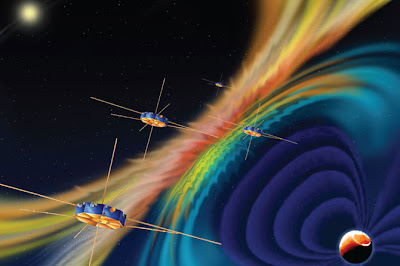
The universe is still an arcane place that scientists know very little about, but a new NASA Solar Terrestrial Probe mission is going to shed light on one especially mysterious event called magnetic reconnection. It occurs when magnetic lines of force cross, cancel, and reconnect releasing magnetic energy in the form of heat and charged-particle kinetic energy.
NASA
On the sun, magnetic reconnection causes solar flares more powerful than several atomic bombs combined. In Earth's atmosphere, magnetic reconnection dispenses magnetic storms and auroras, and in laboratories on Earth it can cause big problems in fusion reactors.

Although the study of magnetic reconnection dates back to the 1950s and despite numerous scientific papers addressing this perplexing issue, scientists still cannot agree on one accepted model.

In 2014, NASA is scheduled to launch a satellite that will greatly increase our understanding of this phenomenon when it launches the Magnetospheric Multiscale (MMS) mission, a suite of four identical spacecraft that will study magnetic reconnection in the best possible laboratory – the Earth’s magnetosphere. The spacecraft will obtain measurements necessary to test prevailing theories as to how reconnection is enabled and how it progresses.

Artist conception of the four Magnetospheric Multiscale (MMS) spacecraft investigating magnetic reconnection within Earth's magnetic field (magnetosphere). Credit: Southwest Research Institute

Recently, NASA and members of an independent review board painstakingly reviewed every aspect of the MMS mission, and successfully completed the mission’s critical design review. This technical review is held to ensure that a mission can proceed into fabrication, demonstration and test and can meet stated performance requirements, including cost, schedule, risk and other system constraints.

According to MMS deputy project scientist Mark Adrian of NASA’s Goddard Space Flight Center in Greenbelt, Md., “This is the last hurdle before the spacecraft and instrument teams begin to build actual flight hardware.”

MMS was approved for implementation in June 2009 following a successful Preliminary Design Review in May 2009.

Dr. James L. Burch of the Southwest Research Institute in San Antonio, Texas, will lead the MMS science team. According to Burch, “Magnetic reconnection is a fundamental physical process that occurs throughout the universe,” says Burch. “MMS will enable us to study this dynamic process in the near-Earth space environment, where it transfers energy from the solar wind to the magnetosphere and drives disturbances known as space weather.”

Goddard is the lead Center for the mission. Engineers there will perform the required environmental testing, build the spacecraft and integrate all four sets of instruments into the MMS satellites, support launch vehicle integration and operations, and develop the Mission Operations Center which to monitor and control the spacecraft.

MMS will carry identical suites of plasma analyzers, energetic particle detectors, magnetometers, and electric field instruments as well as a device to prevent spacecraft charging from interfering with the highly sensitive measurements required in and around the diffusion regions.

Scientists and engineers at Goddard have designed and will build one of the instruments – the Fast Plasma Instrument, which will measure the ion and electron distributions and the electric and magnetic fields with unprecedentedly high millisecond time resolution and accuracy.

Currently, MMS is scheduled to launch in August 2014 from Cape Canaveral Air Force Station, FL aboard an Atlas V rocket.

Thursday, June 17, 2010

NASA's Avionics Testing: There's More Than One String to This Fiddle

Gary Postlethwait, right, and Bert Priest, test technicians with ATK Aerospace Systems of Magna, Utah, make final preparations for testing inside the avionics mounting structure. Credit: ATK
"Having more than one string on a fiddle" is an old phase used to describe someone or something with multiple talents or uses. This expression could be used to describe NASA's avionics string testing -- a developmental testing process that allows engineers to find and fix any bugs in a system by inputting commands and scrutinizing the electronics system’s responses.

NASA and ATK Aerospace Systems of Magna, Utah, prime contractor for the Ares I first stage avionics system, currently are conducting a series of string tests at ATK's test facility in Clearfield, Utah.

So exactly what is an avionics system and how is NASA using string testing to help design the next generation of solid-rocket-motor-based launch systems?

The avionics system is the "brains" for a launch vehicle, consisting of the electronics system, equipment and associated sensors responsible for controlling key guidance, launch, navigation and recovery hardware. The first stage avionics works with the upper stage flight computers and guidance systems to control the vehicle during first stage ascent and executes recovery of the first stage after staging.

During testing, control boxes of the first stage avionics system are wired together in a line -- the so-called string – with multiple strings making up the entire avionics system. The strings are connected to a ground computer which simulates the upper stage flight computer by issuing commands to the appropriate control box, requiring a particular response.

ATK test engineers make final systems checks during avionics string tests. Credit: ATK
"System level or "string" testing is a widely recognized process that allows our team to locate and identify functional and performance-related problems within the hardware," said Kendall Junen, avionics and control team lead for Ares Projects at NASA's Marshall Space Flight Center in Huntsville, Ala. "It involves taking various system requirements and testing the hardware in controlled laboratory scenarios to determine how well the system performs."

"This laboratory allows us to test like you fly. We can assemble the entire avionics system and put it through precise, flight-like scenarios," he said. "We can test the system's reaction to certain computer-generated anomalies and identify potential performance issues associated with specific hardware."

Tuesday, June 08, 2010

Next Stop, Titan: Looking at the Land o' Lakes


NASA's Cassini spacecraft will be eyeing the north polar region of Saturn's moon Titan this weekend, scanning the moon's land o' lakes.

At closest approach on early morning Saturday, June 5 UTC, which is Friday afternoon, June 4 Pacific time, Cassini will glide to within about 2,000 kilometers (1,300 miles) of the Titan surface.

Cassini will make infrared scans of the north polar region, which was in darkness for the first several years of Cassini's tour around the Saturn system. The lighting has improved as northern spring has started to dawn over the area.

The visual and infrared spectrometer will be prime during closest approach, but the imaging science subsystem cameras will also be taking pictures. Among the scientific bounties, Cassini team members are hoping to get another good look at Kraken Mare, the largest lake on Titan, which covers a greater area than the Caspian Sea on Earth.

Although this latest flyby is dubbed "T69," planning changes early in the orbital tour made this the 70th targeted flyby of Titan.

The Cassini-Huygens mission is a cooperative project of NASA, the European Space Agency and the Italian Space Agency. JPL manages the mission for NASA's Science Mission Directorate, Washington, D.C. The Cassini orbiter was designed, developed and assembled at JPL.

Tuesday, May 25, 2010

WISE Makes Progress on its Space Rock Catalog

This shows asteroids and comets observed so far by NASA's Wide-field Infrared Survey Explorer, or WISE.NASA's Wide-field Infrared Survey Explorer, or WISE, is busy surveying the landscape of the infrared sky, building up a catalog of cosmic specimens -- everything from distant galaxies to "failed" stars, called brown dwarfs.

Closer to home, the mission is picking out an impressive collection of asteroids and comets, some known and some never seen before. Most of these hang out in the Main Belt between Mars and Jupiter, but a small number are near-Earth objects -- asteroids and comets with orbits that pass within about 48 million kilometers (30 million miles) of Earth's orbit. By studying a small sample of near-Earth objects, WISE will learn more about the population as a whole. How do their sizes differ, and how many objects are dark versus light?

"We are taking a census of a small sample of near-Earth objects to get a better idea of how they vary," said Amy Mainzer, the principal investigator of NEOWISE, a program to catalog asteroids seen with WISE.

So far, the mission has observed more than 60,000 asteroids, both Main Belt and near-Earth objects. Most were known before, but more than 11,000 are new.

"Our data pipeline is bursting with asteroids," said WISE Principal Investigator Ned Wright of UCLA. "We are discovering about a hundred a day, mostly in the Main Belt."

About 190 near-Earth asteroids have been observed to date, of which more than 50 are new discoveries. All asteroid observations are reported to the NASA-funded International Astronomical Union's Minor Planet Center, a clearinghouse for data on all solar system bodies at the Smithsonian Astrophysical Observatory in Cambridge, Mass.

"It's a really exciting time for asteroid science," said Tim Spahr, who directs the Minor Planet Center. "WISE is another tool to add to our tool belt of instruments to discover and study the asteroid population."

A network of ground-based telescopes follows up and confirms the WISE finds, including the NASA-funded University of Arizona Spacewatch and Catalina Sky Survey projects, both near Tucson, Ariz., and the NASA-funded Magdalena Ridge Observatory near Socorro, N.M.

Some of the near-Earth asteroids detected so far are visibly dark, but it's too early to say what percentage. The team needs time to properly analyze and calibrate the data. When results are ready, they will be published in a peer-reviewed journal. WISE has not found an asteroid yet that would be too dark for detection by visible-light telescopes on the ground.

Tuesday, May 18, 2010

Engineers Diagnosing Voyager 2 Data System


One flip of a bit in the memory of an on board computer appears to have caused the change in the science data pattern returning from Voyager 2, engineers at NASA's Jet Propulsion Laboratory said Monday, May 17. A value in a single memory location was changed from a 0 to a 1.

On May 12, engineers received a full memory readout from the flight data system computer, which formats the data to send back to Earth. They isolated the one bit in the memory that had changed, and they recreated the effect on a computer at JPL. They found the effect agrees with data coming down from the spacecraft. They are planning to reset the bit to its normal state on Wednesday, May 19.

Engineers have shifted NASA's Voyager 2 spacecraft into a mode that transmits only spacecraft health and status data while they diagnose an unexpected change in the pattern of returning data. Preliminary engineering data received on May 1 show the spacecraft is basically healthy, and that the source of the issue is the flight data system, which is responsible for formatting the data to send back to Earth. The change in the data return pattern has prevented mission managers from decoding science data.

The first changes in the return of data packets from Voyager 2, which is near the edge of our solar system, appeared on April 22. Mission team members have been working to troubleshoot and resume the regular flow of science data. Because of a planned roll maneuver and moratorium on sending commands, engineers got their first chance to send commands to the spacecraft on April 30. It takes nearly 13 hours for signals to reach the spacecraft and nearly 13 hours for signals to come down to NASA's Deep Space Network on Earth.

Voyager 2 launched on August 20, 1977, about two weeks before its twin spacecraft, Voyager 1. The two spacecraft are the most distant human-made objects, out at the edge of the heliosphere, the bubble the sun creates around the solar system. Mission managers expect Voyager 1 to leave our solar system and enter interstellar space in the next five years or so, with Voyager 2 on track to enter interstellar space shortly afterward. Voyager 1 is in good health and performing normally.

"Voyager 2's initial mission was a four-year journey to Saturn, but it is still returning data 33 years later," said Ed Stone, Voyager project scientist at the California Institute of Technology in Pasadena. "It has already given us remarkable views of Uranus and Neptune, planets we had never seen close-up before. We will know soon what it will take for it to continue its epic journey of discovery."

The original goals for the two Voyager spacecraft were to explore Jupiter and Saturn.

As part of a mission extension, Voyager 2 also flew by Uranus in 1986 and Neptune in 1989, taking advantage of a once-in-176-year alignment to take a grand tour of the outer planets. Among its many findings, Voyager 2 discovered Neptune's Great Dark Spot and 450-meter-per-second (1,000-mph) winds. It also detected geysers erupting from the pinkish-hued nitrogen ice that forms the polar cap of Neptune's moon Triton. Working in concert with Voyager 1, it also helped discover actively erupting volcanoes on Jupiter's moon Io, and waves and kinks in Saturn's icy rings from the tugs of nearby moons.

Voyager 2 is about 13.8 billion kilometers, or 8.6 billion miles, from Earth. Voyager 1 is about 16.9 billion kilometers (10.5 billion miles) away from Earth.

Thursday, May 06, 2010

Cassini Returning Enceladus Gravity Data

nasaNASA's Cassini spacecraft successfully completed its 26-hour gravity observation at Saturn's moon Enceladus this week, sending back data scientists will use to understand the moon's interior composition and structure.

The flyby took Cassini through the water-rich plume flaring out from Enceladus' south polar region, with a closest approach of about 100 kilometers (60 miles) occurring in the late afternoon of April 27, 2010, Pacific Time, or just after midnight April 28 UTC.

A steady radio link to NASA's Deep Space Network on Earth enabled Cassini's scientists to use the radio science instrument to measure the variations in the gravitational pull of Enceladus. Analyzing the wiggles will help scientists understand whether an ocean, pond or great lake lies under the famous "tiger stripe" fractures that spew water vapor and organic particles from the south polar region.

Results from the experiment will also tell scientists if bubbles of warmer ice in the interior rise toward that region's surface like an underground lava lamp.

Radio science was prime during the flyby and controlled spacecraft pointing. The optical instruments were not pointed at Enceladus during most of the flyby, so the imaging camera obtained some more distant pictures.

Cassini often relies on thrusters to control attitude during flybys such as this one, but this time it turned the thrusters off and relied on its reaction wheels. Using thrusters adds acceleration effects to the spacecraft, complicating the precise measurements needed for the radio science experiment.

The Cassini-Huygens mission is a cooperative project of NASA, the European Space Agency and the Italian Space Agency. The Jet Propulsion Laboratory, a division of the California Institute of Technology in Pasadena, manages the Cassini-Huygens mission for NASA's Science Mission Directorate in Washington. The Cassini orbiter was designed, developed and assembled at JPL.