Wednesday, October 05, 2011

NASA Space Telescope Finds Fewer Asteroids Near Earth


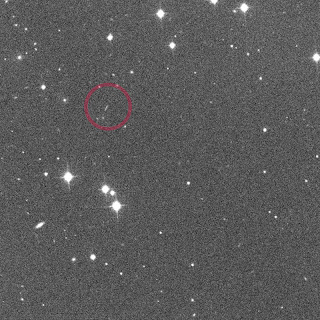
PASADENA, Calif. -- New observations by NASA's Wide-field Infrared Survey Explorer, or WISE, show there are significantly fewer near-Earth asteroids in the mid-size range than previously thought. The findings also indicate NASA has found more than 90 percent of the largest near-Earth asteroids, meeting a goal agreed to with Congress in 1998.

Astronomers now estimate there are roughly 19,500 -- not 35,000 -- mid-size near-Earth asteroids. Scientists say this improved understanding of the population may indicate the hazard to Earth could be somewhat less than previously thought. However, the majority of these mid-size asteroids remain to be discovered. More research also is needed to determine if fewer mid-size objects (between 330 and 3,300-feet wide) also mean fewer potentially hazardous asteroids, those that come closest to Earth.

The results come from the most accurate census to date of near-Earth asteroids, the space rocks that orbit within 120 million miles (195 million kilometers) of the sun into Earth's orbital vicinity. WISE observed infrared light from those in the middle to large-size category. The survey project, called NEOWISE, is the asteroid-hunting portion of the WISE mission. Study results appear in the Astrophysical Journal.

"NEOWISE allowed us to take a look at a more representative slice of the near-Earth asteroid numbers and make better estimates about the whole population," said Amy Mainzer, lead author of the new study and principal investigator for the NEOWISE project at NASA's Jet Propulsion Laboratory in Pasadena, Calif. "It's like a population census, where you poll a small group of people to draw conclusions about the entire country."

WISE scanned the entire celestial sky twice in infrared light between January 2010 and February 2011, continuously snapping pictures of everything from distant galaxies to near-Earth asteroids and comets. NEOWISE observed more than 100 thousand asteroids in the main belt between Mars and Jupiter, in addition to at least 585 near Earth.

WISE captured a more accurate sample of the asteroid population than previous visible-light surveys because its infrared detectors could see both dark and light objects. It is difficult for visible-light telescopes to see the dim amounts of visible-light reflected by dark asteroids. Infrared-sensing telescopes detect an object's heat, which is dependent on size and not reflective properties.

Though the WISE data reveal only a small decline in the estimated numbers for the largest near-Earth asteroids, which are 3,300 feet (1 kilometer) and larger, they show 93 percent of the estimated population have been found. This fulfills the initial "Spaceguard" goal agreed to with Congress. These large asteroids are about the size of a small mountain and would have global consequences if they were to strike Earth. The new data revise their total numbers from about 1,000 down to 981, of which 911 already have been found. None of them represents a threat to Earth in the next few centuries. It is believed that all near-Earth asteroids approximately 6 miles (10 kilometers) across, as big as the one thought to have wiped out the dinosaurs, have been found.

"The risk of a really large asteroid impacting the Earth before we could find and warn of it has been substantially reduced," said Tim Spahr, the director of the Minor Planet Center at the Harvard Smithsonian Center for Astrophysics in Cambridge, Mass.

The situation is different for the mid-size asteroids, which could destroy a metropolitan area if they were to impact in the wrong place. The NEOWISE results find a larger decline in the estimated population for these bodies than what was observed for the largest asteroids. So far, the Spaceguard effort has found and is tracking more than 5,200 near-Earth asteroids 330 feet or larger, leaving more than an estimated 15,000 still to discover. In addition, scientists estimate there are more than a million unknown smaller near-Earth asteroids that could cause damage if they were to impact Earth.

Diamond earring studs

Read more

Monday, October 03, 2011

Obscure Full Moon Names of 2011


Jan. 19, 4:21 p.m. EST – Full Wolf Moon: Amid the zero cold and deep snows of midwinter, the wolf packs howled hungrily outside Indian villages. The Full Wolf Moon was also known as the Old Moon or the Moon After Yule. In some tribes, this was also known as the Full Snow Moon; most applied that name to the next moon.

Feb. 18, 3:36 a.m. EST – Full Snow Moon: Usually the heaviest snows fall in this month. Hunting becomes very difficult, and hence to some tribes this was known as the Full Hunger Moon.

Mar. 19, 2:10 p.m. EDT – Full Worm Moon: In this month, the ground softens and the earthworm casts reappear, inviting the return of the robins.

The more northern tribes knew this as the Full Crow Moon, when the cawing of crows signals the end of winter, or the Full Crust Moon because the snow cover becomes crusted from thawing by day and freezing at night. TheFull Sap Moon, marking the time of tapping maple trees, is another variation.

The moon will also arrive at perigee only 50 minutes later at 3:00 p.m. EDT at a distance of 221,565 miles (356,575 kilometers) from Earth. So this is the biggest full moon of 2011. Very high ocean tides can be expected during the next two or three days, thanks to the coincidence of perigee with full moon.

Apr. 17, 10:44 p.m. EDT – Full Pink Moon
: The grass pink or wild ground phlox is one of the earliest widespread flowers of the spring. Other names were the Full Sprouting Grass Moon, the Egg Moon and – among coastal tribes – the Full Fish Moon, when the shad come upstream to spawn.

In 2011, this is also the Paschal Full Moon; the first full moon of the spring season. The first Sunday following the Paschal Moon is Easter Sunday, which indeed will be observed one week later on Sunday, April 24. This, incidentally, is just one day shy of the latest date that Easter can fall.

May 17, 7:09 a.m. EDT – Full Flower Moon: Flowers are now abundant everywhere. This moon was also known as the Full Corn Planting Moon or the Milk Moon.

Jun. 15, 4:14 p.m. EDT – Full Strawberry Moon: Strawberry picking season peaks during this month. Europeans called this the Rose Moon. There will be also be a total lunar eclipse that will be visible across much of South America, Europe, Africa and Asia. Totality will last an unusually long length of time: 1 hour 40 minutes.

Jul. 15, 2:40 a.m. EDT – Full Buck Moon
: when the new antlers of buck deer push out from their foreheads in coatings of velvety fur. It was also often called the Full Thunder Moon, thunderstorms being now most frequent. Sometimes it's also called the Full Hay Moon.

Aug. 13, 2:57 p.m. EDT – Full Sturgeon Moon: When this large fish of the Great Lakes and other major bodies of water like Lake Champlain is most readily caught. A few tribes knew it as the Full Red Moon because when the moon rises it looks reddish through sultry haze, or the Green Corn Moon or Grain Moon.

The occurrence of this full moon on this particular date is rather poor timing for those who enjoy the annual performance of the Perseid meteor shower; this display will peak on this very same day and the brilliant light of the moon will likely wash out all but the very brightest of these swift streaks of light.

Sep. 12, 5:27 a.m. EDT – Full Harvest Moon
: Traditionally, this designation goes to the full moon that occurs closest to the autumnal (fall) equinox. The Harvest Moon usually comes in September in the Northern Hemisphere, but (on average) once or twice a decade it will fall in early October.

At the peak of the harvest, farmers can work into the night by the light of this moon. Usually the moon rises an average of 50 minutes later each night, but for the few nights around the Harvest Moon, the moon seems to rise at nearly the same time each night – just 25 to 30 minutes later across the U.S., and only 10 to 20 minutes later for much of Canada and Europe. Corn, pumpkins, squash, beans and wild rice – the chief Indian staples – are now ready for gathering.

Diamond stud

Read more

Friday, September 30, 2011

Messenger findings may 'revolutionize' views of Mercury


A spacecraft sent to the least explored rocky planet in the solar system is providing surprising new information that may rewrite what scientists believe about the growth of planets.

Mercury, the tiny planet closest to the sun, has a lopsided magnetic field, much more sulfur than expected and strange "hollows" across its surface that may hint at present-day geologic activity, according to data gleaned by the Messenger spacecraft.

The results, published in a package of seven papers in Friday's edition of the journal Science, may force scientists to throw out many ideas about how Mercury formed.

When Mariner 10 flew by in 1974 and 1975, planetary scientists got a tantalizing glimpse at Mercury's moon-like features — craters, flat plains of ancient lava — and discovered it had a magnetic field. The Messenger mission, armed with a suite of instruments including cameras, element-sensing spectrometers and a magnetic field detector, was designed to answer questions dangled by that decades-old snapshot.

Launched in 2004, the spacecraft flew by the planet three times before entering orbit in March of this year, when it sent the first close-up images back to Earth. It will continue to send data as it circles the planet for about a year.

Mercury, planetary scientists knew, is uncommonly dense — most likely because its inner core of iron is very large relative to the rest of the planet. This led some scientists to theorize that Mercury had once been perhaps two to three times larger and its outer layers had been stripped away, either from the sun's fierce glare or major impacts from asteroids.

As molten balls of rock coalesce to form a planet, the heavier elements such as iron tend to sink toward the center while lighter elements such as sulfur or phosphorus, which are more likely to evaporate, drift in the opposite direction. This, scientists had reasoned, would make those volatile lighter elements the first to get stripped away, leaving the planet comparatively dense.

But when scientists used Messenger's gamma-ray and X-ray spectrometers to analyze elements on Mercury's surface, they found that the planet was rich in phosphorus and that sulfur was 10 times more abundant on the surface than on the Earth or moon.

"At this point, the origin of Mercury's large core is still a mystery," said Larry Nittler, a cosmochemist at the Carnegie Institution of Washington who led the X-ray spectrometer study.

Another paper found that the vast flat plains on Mercury were not caused by eruptions from volcanoes but were fashioned from large amounts of lava that seeped up from cracks in the ground and flooded the surface. The scorching-hot lava also carved teardrop-shaped islands into the surface, which are visible near the edges of these plains.

Mercury is "essentially wallpapered by huge volumes of lava," said James Head, a planetary geoscientist at Brown University and lead author of that study.

"Volcanism is important because it represents the pulse of the planets," he added. "It's like the blood of the interior: Is it not doing much inside, or is it really active?"

Diamond stud

Read more

Wednesday, September 28, 2011

"Dark" Supermoon Tomorrow: New Moon Gets Closest to Earth


Tomorrow night the new moon will make a close approach to Earth, giving rise to the second supermoon of the year—but this one will have the power of invisibility.

Because the moon's orbit is egg shaped, there are times in the roughly monthlong lunar cycle when the moon is at perigee—its closest distance to Earth—or at apogee, its farthest distance from Earth.

"A supermoon occurs when the moon is at perigee and it's in either a full or new phase," said Raminder Singh Samra, an astronomer at the H.R. MacMillan Space Centre in Vancouver, Canada.

In March sky-watchers were treated to a full moon at perigee, which made for the biggest full moon seen in 18 years.

A new moon happens when the lunar orb positions itself between Earth and the sun, so that the side of the moon that faces Earth is unlighted.

"The upcoming moon on September 27, 2011, is set to be at perigee and at the new phase," Samra said, "so we won't be able to witness the event, as the moon and sun will be in the same region of the sky" and the lunar disk will be entirely dark.

Supermoon to Affect Earth's Tides?

Because the size of the moon's orbit also varies slightly, each perigee is not always the same distance from Earth.

When at perigee, the moon is about 18,640 miles (30,000 kilometers) closer to Earth than its average distance of roughly 240,000 miles (385,000 kilometers). When perigee occurs during a full moon, the lunar disk can appear about 14 percent bigger in the sky, Samra said.

Tuesday's dark supermoon will be just 222,175 miles (357,557 kilometers) away from Earth.

Some people have speculated that this lunar proximity can have unusual gravitational effects on Earth, triggering dramatic events such as earthquakes.

Read more

Sunday, September 25, 2011

How Common Are Earth-Moon Planetary Systems


Earth's Moon might have played an important role in the development and evolution of life on Earth. The Moon was formed via a giant impact in which a Mars-size projectile collided with the young Earth. The ejected material accumulated in orbit around our planet and formed the Moon. After its formation, the Moon was much closer to Earth than it is today, which caused high tides several times per day.

This may have helped promote the very early evolution of life. In addition, a stable climate of more than a billion years may be essential to guarantee a suitable environment for life. But without its satellite, Earth would suffer chaotic variations of the direction of its spin axis, which would in turn result in dramatic variations of the climate.

Therefore, concerning the habitability of extrasolar planets, it is reasonable to ask: How common are Earth-Moon planetary systems?

Sebastian Elser, Prof. Ben Moore and Dr. Joachim Stadel of the University of Zurich, Switzerland, along with Ryuji Morishima of NASA's Jet Propulsion Laboratory in Pasadena, California, ran a large set of N-body simulations to study the formation of the rocky planets in our solar system via the collisional growth of thousands of small rocky bodies in a disk around the Sun.

Read more

Friday, September 23, 2011

Plenty of room on planet Earth


The world now has almost seven billion people and rising. The population may surpass nine billion by 2050. We, together with our 20 billion chickens and four billion cattle, sheep and pigs, will utterly dominate the planet. Can the planet take it? Can we take it?

Yes. Not only is such a huge population going to prove indefinitely "sustainable;" it is actually likely that the ecological impact of nine billion in 2050 will be lighter, not heavier: there will be less pollution and more space left over for nature than there is today.

Consider three startling facts. The world population quadrupled in the 20th century, but the calories available per person went up, not down. The world population doubled in the second half of the century, but the total forest area on the planet went up slightly, not down. The world population increased by a billion in the last 13 years, but the number living in absolute poverty (less than a dollar a day, adjusted for inflation) fell by around a third.

Clearly it is possible at least for a while to escape the fate forecast by Robert Malthus, the pessimistic mathematical cleric, in 1798. We've been proving Malthus wrong for more than 200 years. And now the population explosion is fading. Fertility rates are falling all over the world: in Bangladesh it's down from 6.8 children per woman in 1955 to 2.7 today; China - 5.6 to 1.7; Iran - 7 to 1.7; Nigeria - 6.5 to 5.2; Brazil 6.1 to 1.8; Yemen - 8.3 to 5.1.

The rate of growth of world population has halved since the 1960s; the absolute number added to the population each year has been falling for more than 20 years. According to the United Nations, population will probably cease growing by 2070. This miraculous collapse of fertility has not been caused by Malthusian misery or coercion (except in China), but by the opposite: enrichment, urbanization, female emancipation, education and above all the defeat of child mortality - which means women start to plan families rather than continue breeding.

Increasing prosperity means eating more food, though. Can we really feed today's let alone tomorrow's billions? In 60 years we have trebled the total harvest of the three biggest crops: wheat, rice and corn. Yet the acreage devoted to growing these crops has barely changed. This is because fertilizer, irrigation, pesticides and new varieties have greatly increased yields.

They continue to do so. Growth regulators boost the yield of wheat. Genetic modification boosts the yield of cotton (while increasing the biodiversity in fields). New enzymes promise to cut the phosphate output and increase weight gain of pigs. These technologies save rainforest by sparing land from the plow. If we went back to organic farming, the world would have to cultivate more than twice as much land as we do.

Already huge swaths of the world are being released from farming and reforested. New England is now 80 per cent woodland, where it was once 70 per cent farmland. Italy and England have more woodland than they have for centuries. Moose, coyotes, beavers and bears are back in places where they have not been for centuries. France has a wolf problem; Scotland a deer problem. It is the poor countries, not the affluent ones, that are losing forest. Haiti, with its near total dependence on renewable power (wood), is 98 per cent deforested and counting.

Read more


Tuesday, September 20, 2011

Our solar system might have once had an extra gas planet


This solar system just doesn't work. According to a new computer simulation, the planets could never have come together in their current configuration. The only explanation is that we once had a fifth gas giant...and it's still out there somewhere.

That's a pretty big claim to make, so let's see how David Nesvorny of Colorado's Southwest Research Institute reached that particular conclusion. The key idea here is that our solar system wouldn't have formed in its present configuration — the planets would have tugged on each other as they formed, pulling each other out of their original orbits and into new ones. The solar system doesn't begin fully-formed, even once the various planets are complete. It's still a long evolutionary process.

We can't know exactly how the planets first fit together, so Nesvorny simply tried a bunch of different possible starting positions and ran simulations to find out which could conceivably result in the present solar system. The problem is that Jupiter, Saturn, Uranus, and Neptune are just so damn big that they can barely move around without violently disrupting each other's orbits.

In the vast majority of simulations, one gas giant would rip another apart. Even in simulations where all four gas giants survived, it was often at the expense of the rocky planets. According to Nesvorny's simulation, the current solar system is of astoundingly low probability, assuming we're only starting with four inner rocky planets and four outer gas planets. It's when you alter that assumption that things start to get interesting.

By adding a fifth gas planet into the mix, Nesvorny found that the odds of our current solar system emerging increased dramatically. That's obviously not proof of this fifth gas planet's existence, but if this computer simulation holds up, then it's actually more likely than not.

Read more

Monday, September 19, 2011

Fifty New Exoplanets Discovered by HARPS


Astronomers using ESO’s world-leading exoplanet hunter HARPS have today announced a rich haul of more than 50 new exoplanets, including 16 super-Earths, one of which orbits at the edge of the habitable zone of its star. By studying the properties of all the HARPS planets found so far, the team has found that about 40% of stars similar to the Sun have at least one planet lighter than Saturn.

The HARPS spectrograph on the 3.6-metre telescope at ESO’s La Silla Observatory in Chile is the world’s most successful planet finder [1]. The HARPS team, led by Michel Mayor (University of Geneva, Switzerland), today announced the discovery of more than 50 new exoplanets orbiting nearby stars, including sixteen super-Earths [2]. This is the largest number of such planets ever announced at one time [3]. The new findings are being presented at a conference on Extreme Solar Systems where 350 exoplanet experts are meeting in Wyoming, USA.

“The harvest of discoveries from HARPS has exceeded all expectations and includes an exceptionally rich population of super-Earths and Neptune-type planets hosted by stars very similar to our Sun. And even better — the new results show that the pace of discovery is accelerating,” says Mayor.

In the eight years since it started surveying stars like the Sun using the radial velocity technique HARPS has been used to discover more than 150 new planets. About two thirds of all the known exoplanets with masses less than that of Neptune [4] were discovered by HARPS. These exceptional results are the fruit of several hundred nights of HARPS observations [5].

Working with HARPS observations of 376 Sun-like stars, astronomers have now also much improved the estimate of how likely it is that a star like the Sun is host to low-mass planets (as opposed to gaseous giants). They find that about 40% of such stars have at least one planet less massive than Saturn. The majority of exoplanets of Neptune mass or less appear to be in systems with multiple planets.

With upgrades to both hardware and software systems in progress, HARPS is being pushed to the next level of stability and sensitivity to search for rocky planets that could support life. Ten nearby stars similar to the Sun were selected for a new survey. These stars had already been observed by HARPS and are known to be suitable for extremely precise radial velocity measurements. After two years of work, the team of astronomers has discovered five new planets with masses less than five times that of Earth.

Read more

Tuesday, September 13, 2011

16 'super-Earths' found outside solar system


It's not like aliens put up a welcome banner or anything, but scientists now have newly identified at least one planet that could potentially sustain life.

The European Southern Observatory has just announced the discovery of more than 50 new exoplanets (planets outside our solar system), including 16 super-Earths (planets whose mass is between one and 10 times that of our own planet).

One of these planets in particular could theoretically be home to life if conditions are right. It's called HD 85512 b, and scientists say it's about 3.6 times the mass of the Earth. This planet is about 35 light years from Earth. Its location with respect to its star suggests that this planet could have liquid water under certain circumstances.

Don't get too excited, though; there's a lot more work to be done to explore whether this planet is truly fit for life, in addition to whether there are alien life forms there.

The discovery comes from High Accuracy Radial Velocity Planet Searcher, or HARPS. HARPS is located at the La Silla Observatory in Chile, and is part of a telescope that's nearly 12 feet long.

Here's how it works, according to ESO: When a planet orbits a star, the star move towards and away from the person who's stargazing on Earth in a regular fashion. That's called a change in radial velocity. Because of the Doppler effect, changes in radial velocity makes the star's light spectrum move towards longer wavelengths when it's moving away, and towards shorter wavelengths as it gets closer. HARPS can detect this shift in the spectrum, and infer that there is a planet present.

Read more

Sunday, July 17, 2011

Solar system with Earth-size planet found

After six years of painstaking observations, astronomers have identified a distant solar system with at least five Neptune-class worlds orbiting within 130 million miles or so of the parent star--closer than Mars is to the sun. Two other planets are believed to be present, including one just 1.4 times as massive as Earth.

The presumed Earth-size planet orbits a scant 2 million miles from its star, completing a full orbit, or "year," every 1.18 days. If confirmed with additional observations, this hellish world would be the smallest yet discovered, additional proof that Earth-size planets are falling within the reach of current Earth-based instruments.

"We have probably found the system with the most planets known today, coming close to the solar system," Christophe Lovis of the University of Geneva, lead author of a paper reporting the discovery, told CNET in an e-mail exchange. "This means that we are now able to detect very complex systems of low-mass planets, which will help us a lot [in] understanding their diversity. This a step towards answering long-standing questions, such as, how common are habitable planets in the universe?"

As for the presumed Earth-size planet, Lovis said "it is probable that such a low-mass body cannot retain an atmosphere so close to its star. Most likely, this body is like a big melted-lava ball. Hard to imagine, since this is unknown in our solar system."

Over six years, Lovis and his colleagues used a sensitive spectrograph mounted on the European Southern Observatory's 3.6-meter (11.8-foot) telescope at La Silla, Chile, to measure subtle changes in the light from a sun-like star known as HD 10180 in the southern constellation Hydrus.

Located 127 light-years from Earth, HD 10180 wobbles ever so slightly, as it is tugged this way and that by the gravity of a retinue of unseen planets. Over the course of 190 observations, astronomers were able to confirm the presence of at least five Neptune-like planets between 13 and 25 times as massive as Earth.

All five worlds orbit HD 10180 at distances ranging from 0.06 and 1.4 times the distance between the Earth and the sun, out to about 130 million miles. The much smaller, yet-to-be-confirmed planet orbits inside the five Neptune-class worlds. A seventh Saturn-class planet is believed to be at a range of 3.4 times the Earth-sun distance, taking six Earth years to complete one orbit.

According to the Extrasolar Planets Encyclopaedia maintained by the Paris Observatory, 488 planets beyond Earth's solar system have been discovered to date. Some 15 solar systems feature at least three planets. A star known as 55 Cancri has five confirmed planets, including two Jupiter-class worlds.

The HD 10180 solar system is unique in that its planets circle the parent star in nearly circular orbits and seem to be positioned according to a relatively simple arithmetic rule that may be "a consequence of the various gravitational interactions that occur between the planets during their evolution," Lovis said.

"It is difficult to say at this point how significant this result is, but it will be very interesting to hear what our theoretician colleagues think of it," he added.

Surprisingly, perhaps, it appears the HD 10180 solar system is gravitationally stable over long time scales, despite the effects of five Neptune-class planets orbiting so close to their star.

"This was not an easy question, and answering it required in-depth dynamical analyses," Lovis said. "When modeling all major effects properly (including effects of general relativity), it turns out that the system is indeed stable over long time scales."

He said additional observations will be needed to pin down the orbit and mass of the innermost, Earth-class planet.

"We will dedicate some more telescope nights to observe the star...to improve the coverage of the 1.18-day period," he said of the smaller planet. "At the moment, we are suffering from the fact that we take one single data point per night, which makes it difficult to be sure about a 1.18-day period. I expect that we will make progress on this system within a year or so."

The observations are extremely difficult. The gravitational tug of the low-mass planet amounts to a 1.8 mph wobble in a star 127 light-years away, "which is hard to measure and, if confirmed, would represent a new record in precision," Lovis said.


read more

Tuesday, July 12, 2011

Dawn Team Members Check out Spacecraft


Dawn Mission Status Update

Mission managers for NASA's Dawn spacecraft are studying the spacecraft's ion propulsion system after Dawn experienced a loss of thrust on June 27. Dawn team members were able to trace the episode to an electronic circuit in the spacecraft's digital control and interface unit, a subsystem that houses the circuit and a computer that provides the "brains" to Dawn's ion propulsion system. That circuit appeared to lose an electronic signal. As a result, the valves controlling the flow of xenon fuel did not open properly. Dawn automatically put itself into a more basic configuration known as "safe-communications" mode, where the spacecraft stopped some activities and turned its high-gain antenna to Earth.

Engineers were able to return the spacecraft to a normal configuration and restart the spacecraft's thrusting on June 30 by switching to a second digital control and interface unit with equivalent capabilities. One set of images for navigation purposes was not obtained on June 28 because the spacecraft was in safe-communications mode, and one other set, on July 6, was not obtained to allow the spacecraft to spend the time thrusting. Other sets of navigation images have been and will be acquired as expected. The ion propulsion system is now functioning normally.

"Dawn is still on track to get into orbit around Vesta, and thanks to the flexibility provided by our use of ion propulsion, the time of orbit capture actually will move earlier by a little less than a day," said Marc Rayman, Dawn's chief engineer and mission manager. "More importantly, the rest of Dawn's schedule is unaffected, and science collection is expected to begin as scheduled in early August."

In an unrelated event, the visible and infrared mapping spectrometer on Dawn reset itself on June 29. At the time of the reset, the instrument was gathering calibration data during the spacecraft's approach to the giant asteroid Vesta. Some of its planned observations were completed successfully before automatic sensors turned the instrument off.

On June 30, Dawn team members were able to trace the reset to an internal error in the instrument's central processing unit, though they don't yet know why the internal error occurred. By temporarily turning the instrument back on, the Dawn team confirmed that the instrument is otherwise in a normal configuration. They powered the instrument back off, as originally planned for this time. Team members are working to determine when they will turn it back on again.

After arriving at Vesta, Dawn will spend about one year orbiting the asteroid, which is also known as a protoplanet because it is a large body that almost became a planet. Data collected at Vesta will help scientists understand the earliest chapter of our solar system's history.

The Dawn mission to Vesta and Ceres is managed by the Jet Propulsion Laboratory, a division of the California Institute of Technology in Pasadena, for NASA's Science Mission Directorate, Washington. Dawn is a project of the directorate's Discovery Program, managed by NASA's Marshall Space Flight Center in Huntsville, Ala. The University of California, Los Angeles, is responsible for overall Dawn mission science. Other scientific partners include Planetary Science Institute, Tucson, Ariz.; Max Planck Institute for Solar System Research, Katlenburg-Lindau, Germany; DLR Institute for Planetary Research, Berlin, Germany; Italian National Institute for Astrophysics, Rome; and the Italian Space Agency, Rome. Orbital Sciences Corporation of Dulles, Va., designed and built the Dawn spacecraft.

read more

Friday, July 01, 2011

NASA's Spitzer Finds Distant Galaxies Grazed on Gas


PASADENA, Calif. -- Galaxies once thought of as voracious tigers are more like grazing cows, according to a new study using NASA's Spitzer Space Telescope.

Astronomers have discovered that galaxies in the distant, early universe continuously ingested their star-making fuel over long periods of time. This goes against previous theories that the galaxies devoured their fuel in quick bursts after run-ins with other galaxies.

"Our study shows the merging of massive galaxies was not the dominant method of galaxy growth in the distant universe," said Ranga-Ram Chary of NASA's Spitzer Science Center at the California Institute of Technology in Pasadena, Calif. "We're finding this type of galactic cannibalism was rare. Instead, we are seeing evidence for a mechanism of galaxy growth in which a typical galaxy fed itself through a steady stream of gas, making stars at a much faster rate than previously thought."

Chary is the principal investigator of the research, appearing in the Aug. 1 issue of the Astrophysical Journal. According to his findings, these grazing galaxies fed steadily over periods of hundreds of millions of years and created an unusual amount of plump stars, up to 100 times the mass of our sun.

"This is the first time that we have identified galaxies that supersized themselves by grazing," said Hyunjin Shim, also of the Spitzer Science Center and lead author of the paper. "They have many more massive stars than our Milky Way galaxy."

Galaxies like our Milky Way are giant collections of stars, gas and dust. They grow in size by feeding off gas and converting it to new stars. A long-standing question in astronomy is: Where did distant galaxies that formed billions of years ago acquire this stellar fuel? The most favored theory was that galaxies grew by merging with other galaxies, feeding off gas stirred up in the collisions.

Chary and his team addressed this question by using Spitzer to survey more than 70 remote galaxies that existed 1 to 2 billion years after the Big Bang (our universe is approximately 13.7 billion years old). To their surprise, these galaxies were blazing with what is called H alpha, which is radiation from hydrogen gas that has been hit with ultraviolet light from stars. High levels of H alpha indicate stars are forming vigorously. Seventy percent of the surveyed galaxies show strong signs of H alpha. By contrast, only 0.1 percent of galaxies in our local universe possess this signature.

Previous studies using ultraviolet-light telescopes found about six times less star formation than Spitzer, which sees infrared light. Scientists think this may be due to large amounts of obscuring dust, through which infrared light can sneak. Spitzer opened a new window onto the galaxies by taking very long-exposure infrared images of a patch of sky called the GOODS fields, for Great Observatories Origins Deep Survey.

Further analyses showed that these galaxies furiously formed stars up to 100 times faster than the current star-formation rate of our Milky Way. What's more, the star formation took place over a long period of time, hundreds of millions of years. This tells astronomers that the galaxies did not grow due to mergers, or collisions, which happen on shorter timescales. While such smash-ups are common in the universe -- for example, our Milky Way will merge with the Andromeda galaxy in about 5 billion years -- the new study shows that large mergers were not the main cause of galaxy growth. Instead, the results show that distant, giant galaxies bulked up by feeding off a steady supply of gas that probably streamed in from filaments of dark matter.

Chary said, "If you could visit a planet in one of these galaxies, the sky would be a crazy place, with tons of bright stars, and fairly frequent supernova explosions."

NASA's Jet Propulsion Laboratory in Pasadena, Calif., manages the Spitzer Space Telescope mission for the agency's Science Mission Directorate in Washington. Science operations are conducted at the Spitzer Science Center at Caltech. Caltech manages JPL for NASA.

Saturday, June 25, 2011

New Animation Depicts Next Mars Rover in Action

Although NASA's Mars Science Laboratory will not leave Earth until late this year nor land on Mars until August 2012, anyone can watch those dramatic events now in a new animation of the mission.

The full, 11-minute animation shows sequences such as the spacecraft separating from its launch vehicle near Earth and the mission's rover, Curiosity, zapping rocks with a laser and examining samples of powdered rock on Mars.

Curiosity's landing will use a different method than any previous Mars landing, with the rover suspended on tethers from a rocket-backpack "sky crane."

The new animation combines detailed views of the spacecraft with scenes of real places on Mars, based on stereo images taken by earlier missions.

"It is a treat for the 2,000 or more people who have worked on the Mars Science Laboratory during the past eight years to watch these action scenes of the hardware the project has developed and assembled," said Mars Science Laboratory Project Manager Pete Theisinger at NASA's Jet Propulsion Laboratory, Pasadena, Calif. "The animation also provides an exciting view of this mission for any fan of adventure and exploration."

JPL manages the Mars Science Laboratory project for the NASA Science Mission Directorate, Washington. The rover and other parts of the spacecraft have been delivered to NASA Kennedy Space Center in Florida for launch during the period of Nov. 25 to Dec. 18, 2011. In August 2012, Curiosity will land on Mars for a two-year mission to examine whether conditions in the landing area have been favorable for microbial life and for preserving evidence about whether life has existed there. JPL is a division of the California Institute of Technology, Pasadena.

Thursday, June 23, 2011

NASA SAYS SUN AND PLANETS CONSTRUCTED DIFFERENTLY


PASADENA, Calif. - Researchers analyzing samples returned by NASA's 2004 Genesis mission have discovered that our sun and its inner planets may have formed differently than previously thought.

Data revealed differences between the sun and planets in oxygen and nitrogen, which are two of the most abundant elements in our solar system. Although the difference is slight, the implications could help determine how our solar system evolved.

"We found that Earth, the moon, as well as Martian and other meteorites which are samples of asteroids, have a lower concentration of the O-16 than does the sun," said Kevin McKeegan, a Genesis co-investigator from UCLA, and the lead author of one of two Science papers published this week. "The implication is that we did not form out of the same solar nebula materials that created the sun -- just how and why remains to be discovered."

The air on Earth contains three different kinds of oxygen atoms which are differentiated by the number of neutrons they contain. Nearly 100 percent of oxygen atoms in the solar system are composed of O-16, but there are also tiny amounts of more exotic oxygen isotopes called O-17 and O-18. Researchers studying the oxygen of Genesis samples found that the percentage of O-16 in the sun is slightly higher than on Earth or on other terrestrial planets. The other isotopes' percentages were slightly lower.


Another paper detailed differences between the sun and planets in the element nitrogen. Like oxygen, nitrogen has one isotope, N-14, that makes up nearly 100 percent of the atoms in the solar system, but there is also a tiny amount of N-15. Researchers studying the same samples saw that when compared to Earth's atmosphere, nitrogen in the sun and Jupiter has slightly more N-14, but 40 percent less N-15. Both the sun and Jupiter appear to have the same nitrogen composition. As is the case for oxygen, Earth and the rest of the inner solar system are very different in nitrogen.

"These findings show that all solar system objects including the terrestrial planets, meteorites and comets are anomalous compared to the initial composition of the nebula from which the solar system formed," said Bernard Marty, a Genesis co-investigator from Centre de Recherches Pétrographiques et Géochimiques and the lead author of the other new Science paper. "Understanding the cause of such a heterogeneity will impact our view on the formation of the solar system."


Data were obtained from analysis of samples Genesis collected from the solar wind, or material ejected from the outer portion of the sun. This material can be thought of as a fossil of our nebula because the preponderance of scientific evidence suggests that the outer layer of our sun has not changed measurably for billions of years.

"The sun houses more than 99 percent of the material currently in our solar system, so it's a good idea to get to know it better," said Genesis Principal Investigator Don Burnett of the California Institute of Technology, Pasadena, Calif. "While it was more challenging than expected, we have answered some important questions, and like all successful missions, generated plenty more."

Genesis launched in August 2000. The spacecraft traveled to Earth's L1 Lagrange Point about 1 million miles from Earth, where it remained for 886 days between 2001 and 2004, passively collecting solar-wind samples.

On Sept. 8, 2004, the spacecraft released a sample return capsule, which entered Earth's atmosphere. Although the capsule made a hard landing as a result of a failed parachute in the Utah Test and Training Range in Dugway, Utah, it marked NASA's first sample return since the final Apollo lunar mission in 1972, and the first material collected beyond the moon. NASA's Johnson Space Center in Houston curates the samples and supports analysis and sample allocation.

The Jet Propulsion Laboratory, Pasadena, Calif., managed the Genesis mission for NASA's Science Mission Directorate, Washington. The Genesis mission was part of the Discovery Program managed at NASA's Marshall Space Flight Center in Huntsville, Ala. Lockheed Martin Space Systems, Denver, developed and operated the spacecraft. Analysis at the Centre de Recherches Pétrographiques et Géochimiques, Nancy, France, was supported by the Centre National d'Etudes Spatiales, Paris, and the Centre National de la Recherche Scientifique, Paris, France.

Monday, May 09, 2011

Astronomers Find Newly Discovered Asteroid Is Earth's Companion


Astronomers from the Armagh Observatory in Northern Ireland have found that a recently discovered asteroid has been following Earth in its motion around the Sun for at least the past 250,000 years, and may be intimately related to the origin of our planet.

The asteroid first caught the eye of the scientists, Apostolos "Tolis" Christou and David Asher, two months after it was found by the WISE infrared survey satellite, launched in 2009 by the United States. "Its average distance from the Sun is identical to that of the Earth,", "but what really impressed me at the time was how Earth-like its orbit was." Most near-Earth Asteroids -- NEAs for short -- have very eccentric, or egg-shaped, orbits that take the asteroid right through the inner solar system. But the new object, designated 2010 SO16, is different. Its orbit is almost circular so that it cannot come close to any other planet in the solar system except Earth.

The researchers set out to investigate how stable this orbit is and how long the asteroid has occupied it. To do that, they first had to take into account the current uncertainty in the asteroid's orbit. "Not knowing precisely the location of a newly-discovered NEA is quite common," explained Dr Asher. "The only way to eliminate the uncertainty is to keep tracking the asteroid for as long as possible, usually months or years." But the two scientists overcame that problem by creating virtual "clones" of the asteroid for every possible orbit that it could conceivably occupy. They then simulated the evolution of these clones under the gravity of the Sun and the planets for two million years into the past and in the future.

read more

Sunday, May 08, 2011

Comet Elenin: Preview of a Coming Attraction


Comet Elenin, was first detected on Dec. 10, 2010 by Leonid Elenin, an observer in Lyubertsy, Russia, who made the discovery "remotely" using the ISON-NM observatory near Mayhill, New Mexico. At the time of the discovery, the comet was about 647 million kilometers from Earth. Over the past four-and-a-half months, the comet has - as comets do - closed the distance to Earth's vicinity as it makes its way closer to perihelion. As of May 4, Elenin's distance is about 274 million kilometers.

"That is what happens with these long-period comets that come in from way outside our planetary system," said Don Yeomans of NASA's Near-Earth Object Program Office at NASA's Jet Propulsion Laboratory in Pasadena, Calif. "They make these long, majestic, speedy arcs through our solar system, and sometimes they put on a great show. But not Elenin. Right now that comet looks kind of wimpy."

read more

Friday, May 06, 2011

Mars Express Sees Deep Fractures on Mars


Newly released images from the European Space Agency's Mars Express show Nili Fossae, a system of deep fractures around the giant Isidis impact basin. Some of these incisions into the martian crust are up to 500 m deep and probably formed at the same time as the basin.

Nili Fossae is a 'graben' system on Mars, northeast of the Syrtis Major volcanic province, on the northwestern edge of the giant Isidis impact basin. Graben refers to the lowered terrain between two parallel faults or fractures in the rocks that collapses when tectonic forces pull the area apart. The Nili Fossae system contains numerous graben concentrically oriented around the edges of the basin.

It is thought that flooding of the basin with basaltic lava after the impact that created it resulted in subsidence of the basin floor, adding stress to the planet's crust, which was released by the formation of the fractures.

A strongly eroded impact crater is visible to the bottom right of the image. It measures about 12 km across and exhibits an ejecta blanket, usually formed by material thrown out during the impact. Two landslides have taken place to the west of the crater. Whether they were a direct result of the impact or occurred later is unknown.

read more

Thursday, May 05, 2011

Mars Tribute Marks Memories of Shepard's Flight


The team exploring Mars via NASA's Opportunity rover for the past seven years has informally named a Martian crater for the Mercury spacecraft that astronaut Alan Shepard christened Freedom 7. On May 5, 1961, Shepard piloted Freedom 7 in America's first human spaceflight.

The team is using Opportunity this week to acquire images covering a cluster of small, relatively young craters along the rover's route toward a long-term destination. The cluster's largest crater, spanning about 25 meters , is the one called "Freedom 7." The diameter of Freedom 7 crater, about 25 meters, happens to be equivalent to the height of the Redstone rocket that launched Shepard's flight.

"Many of the people currently involved with the robotic investigations of Mars were first inspired by the astronauts of the Mercury Project who paved the way for the exploration of our solar system," said Scott McLennan of the State University of New York at Stony Brook, who is this week's long-term planning leader for the rover science team. Shepard's flight was the first of six Project Mercury missions piloted by solo astronauts.

read more

Tuesday, May 03, 2011

Dawn Reaches Milestone Approaching Asteroid Vesta


NASA's Dawn spacecraft has reached its official approach phase to the asteroid Vesta and will begin using cameras for the first time to aid navigation for an expected July 16 orbital encounter. The large asteroid is known as a protoplanet – a celestial body that almost formed into a planet.

At the start of this three-month final approach to this massive body in the asteroid belt, Dawn is 1.21 million kilometers (752,000 miles) from Vesta, or about three times the distance between Earth and the moon. During the approach phase, the spacecraft's main activity will be thrusting with a special, hyper-efficient ion engine that uses electricity to ionize and accelerate xenon. The 12-inch-wide ion thrusters provide less thrust than conventional engines, but will provide propulsion for years during the mission and provide far greater capability to change velocity. "We feel a little like Columbus approaching the shores of the New World," said Christopher Russell, Dawn principal investigator, based at the University of California in Los Angeles (UCLA). "The Dawn team can't wait to start mapping this Terra Incognita."

read more

Monday, May 02, 2011

Plasmoids and Sheaths Mean Success or Failure for Solar Eruptions


Our Sun experiences regular eruptions of material into space, but solar physicists still have difficulty in explaining why these dramatic events take place. Now a group of scientists from the University of St Andrews think they have the answer: clouds of plasma constrained by magnetic fields and known as 'plasmoids' that struggle to break free of the Sun's magnetic field.

Active regions on the solar surface are often the site of eruptions. These are associated with magnetic fields from the solar interior rising to the surface and gradually expanding into the Sun's outer atmosphere, the corona, in a process known as magnetic flux emergence. The St Andrews team developed 3D computer models of these phenomena, revealing that the emergence of magnetic flux naturally leads to the formation and expulsion of plasmoids that adopt a twisted tube configuration.

read more